

Difference Between Laser Sensor Radar & Standard Microwave Radar for Industrial High Speed Doors
Full Text Quick Overview
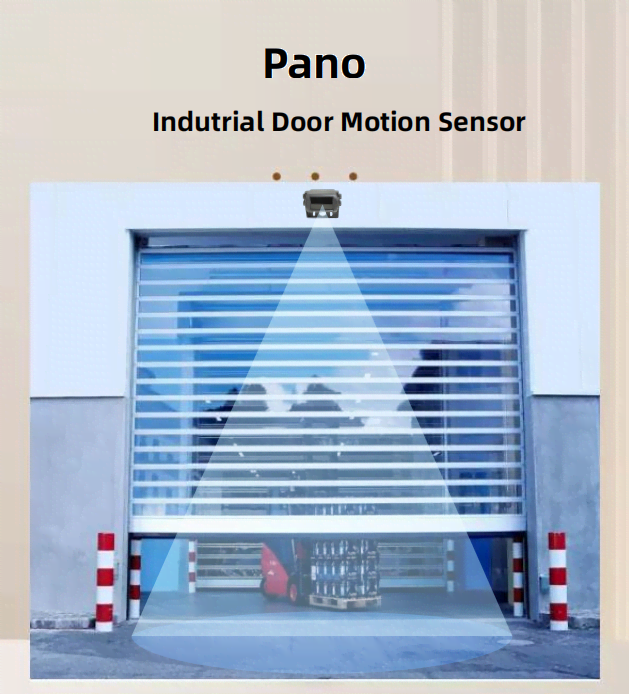
This article breaks down the fundamental differences between two types of motion sensors for high-speed doors, tailored for cold storage operators, factory warehouse managers and logistics park supervisors:
Standard Microwave Radar: Detects moving objects via Doppler electromagnetic waves with low upfront cost. However, it suffers from frequent false triggers, cannot distinguish pedestrians from vehicles, malfunctions in harsh environments, and fails to detect stationary obstacles. It is only suitable for low-traffic, clean standard factories.
Laser Sensor Radar: Adopts vehicle-grade TOF laser ranging technology with millimeter-level precise positioning. It supports custom detection zoning, separate recognition for people and vehicles, stable operation down to -40°C in cold storage, and remote parameter adjustment via mobile APP. It delivers an extra 15%+ energy saving rate compared to standard radar, fundamentally solving cold air loss, door collision and unnecessary door opening energy waste.
The article analyzes the topic in three progressive layers: application scenario selection requirements, complete unit operation logic, and micro component precision gaps. It includes full parameter comparison charts, measurable operational benefits, applicable user groups & working scenarios, plus industry FAQ at the bottom. It can be directly referenced for equipment selection, cost calculation and maintenance management.
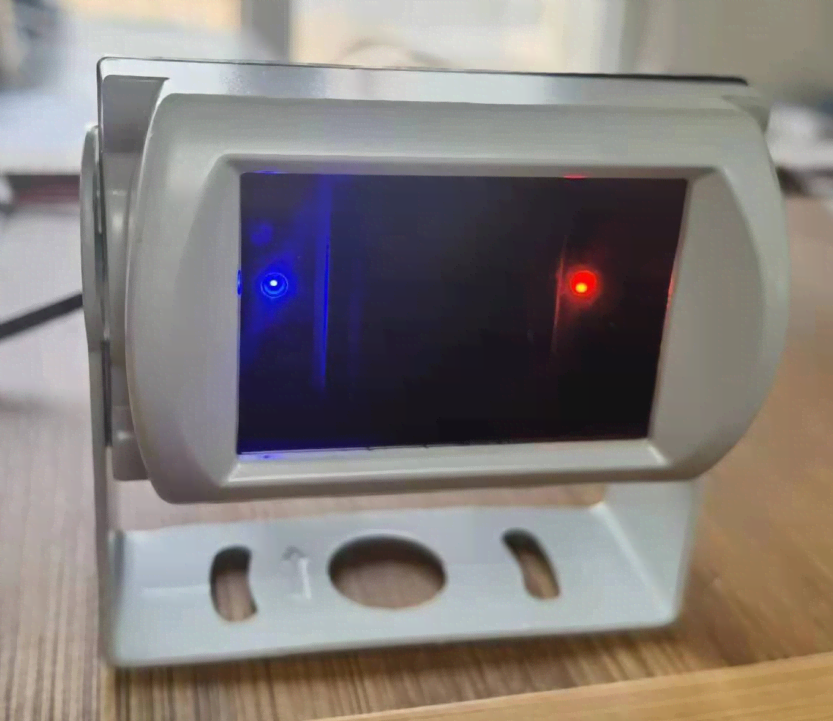
Key Points List
✅ Standard Microwave Radar: $12 – $60 unit price, only detects moving targets, false trigger rate exceeds 30% under dust, fog or strong wind, no zoning function, fails to protect stationary people under door opening;
✅ Laser Sensor Radar: Maximum detection distance up to 10 meters, millimeter ranging accuracy, fine zoning down to less than 2㎡, separate partial opening for pedestrians & full opening for forklifts, stable operation at -40°C cold storage;
✅ Target End Users: Cold chain cold storage, high-frequency logistics loading zones, mixed pedestrian & vehicle heavy industrial plants, food workshops requiring superior air tightness are prioritized for laser radar; small ambient-temperature warehouses & low-footfall workshops can adopt standard microwave radar to control budget;
✅ Industry Pain Points Solved: Excessive cold loss & surging refrigeration bills caused by random door opening via standard radar, door impact damage to forklifts & goods, personnel pinching hazards from stationary detection failure, frequent shutdowns triggered by sensor malfunction in dusty & foggy environments.
I. Scenario Selection Logic: Suitable Factory Environments & Pain Points Solved by Each Radar Type
Many plant managers only focus on the price gap ranging from dozens to thousands of dollars, ignoring that motion sensors directly determine the energy consumption, safety risk and maintenance cost of high-speed doors. The core value of rapid rolling doors is to minimize door opening duration and lock indoor cold temperature. If sensors trigger unnecessary openings or miss obstacle detection frequently, all energy-saving design of the door set becomes ineffective.
Standard microwave radar was originally designed for indoor automatic doors in shopping malls & office buildings, and it cannot adapt to harsh industrial conditions by nature. Laser sensor radar is custom-developed for industrial cold storage and heavy-duty logistics aisles, completely covering all functional defects of microwave radar. We first clarify the applicable boundary of each product via scenario classification:
1. Applicable Scenarios for Standard Microwave Radar (Only Recommended for Low-Demand Working Conditions)
Small ambient-temperature warehouses with forklift traffic less than 50 times per day, free of heavy dust or water mist;
Pure pedestrian passageways without mixed truck & forklift traffic, no strong wind or floating debris outside door openings;
Facilities with tight budget, low sensitivity to energy loss, acceptable minor cold waste from unintended door openings every day.
2. Applicable Scenarios for Laser Sensor Radar (Mandatory High-Demand Working Conditions)
Low-temperature cold storage (-18℃ ~ -40℃) and quick-freezing processing workshops with extreme indoor-outdoor temperature difference & high refrigeration energy cost;
High-frequency logistics loading aisles with over 200 forklift passages daily and simultaneous pedestrian & vehicle flow;
Heavy-dust workshops (construction material, food powder processing), outdoor loading bays, factories with permanent fog & humid climate;
Enterprises with strict safety production standards to eliminate door falling hazards to personnel and forklift cargo collision damage.
| Comparison Item | Standard Microwave Radar | Laser Sensor Radar (LS90 Vehicle-Grade) |
|---|---|---|
| Detection Principle | Emits 24GHz microwave, only identifies moving targets via Doppler effect | TOF laser time-of-flight ranging, millimeter full-scan detection for all objects, identifies both stationary & moving targets |
| Max Detection Range | Adjustable 0.5 – 5 meters | 0.1 – 10 meters, long-distance anti-collision early warning |
| Ranging Precision | Decimeter-level, incapable of precise zone division | Millimeter-level, minimum detection zone under 2㎡, supports separate pedestrian & vehicle control |
| Extreme Environment Stability | 30%+ false trigger rate under dust, fog, rain, snow & strong light; sensitivity drops sharply below -10℃; interfered by metal equipment & Wi-Fi signals | Vehicle-grade laser chip, immune to dust, fog, rain, snow and strong light; zero false alarms at -40℃ cold storage, strong anti-electromagnetic interference performance |
| Intelligent Zoning Control | No zoning function, full door opening for any moving object; full opening triggered by passing pedestrians leading to massive cold air leakage | Custom detection zones via mobile APP, configurable for "partial opening for pedestrians, full opening for forklifts", reduces door opening area & lifts energy efficiency by 15%+ |
| Stationary Obstacle Detection | Cannot detect stationary people standing under door; door falls automatically after delay, causing pinching accidents | Continuous full-area scanning for all objects (stationary & moving), door instantly rebounds & stops when obstacles detected during descent, dual-layer safety protection |
| Commissioning & Maintenance Method | Sensitivity adjusted via body rotary knob, requires ladder disassembly for tuning, no visual range indicator, difficult fault diagnosis | Remote parameter setting via mobile APP Bluetooth, built-in visible light spot to mark detection boundary, no ladder or disassembly required, maintenance efficiency improved by 70% |
| Upfront Purchase Cost | $12 – $60, low initial investment | $120 – $450, higher upfront expenditure |
| Long-Term Comprehensive Benefit | Excess cold loss from unintended openings leads to 15%-25% higher monthly refrigeration power consumption; extra repair & compensation cost from frequent forklift collisions & personnel pinching; regular ladder adjustment occupies labor hours monthly | Precise zoning minimizes hot-cold air exchange & slashes cooling electricity bills; anti-collision & anti-pinch functions cut equipment repair & cargo damage cost; remote wireless tuning eliminates regular ladder maintenance labor |
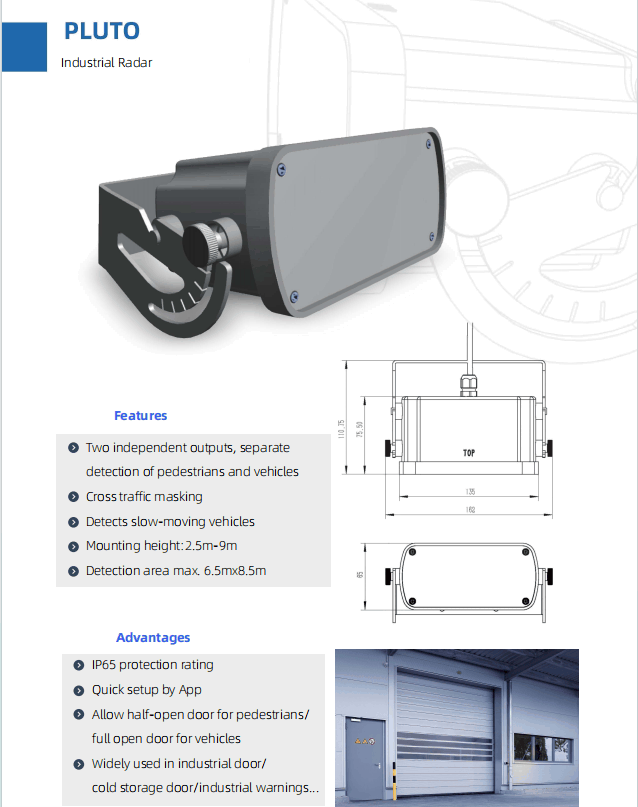
II. Complete Unit Operation Logic: Mid-Level Functional Differences Between Two Radar Types
Motion radar acts as the "vision system" for high-speed industrial doors. The full set of door opening, anti-collision and delayed closing logic is controlled by signal output from this sensor. The two devices adopt completely different core working flows, which directly determine door safety performance and energy-saving efficiency.
2.1 Working Principle & Inherent Defects of Standard Microwave Radar
Microwave Radar (Standard Radar) (First Definition: An induction sensor transmitting high-frequency radio microwave and judging object movement via Doppler frequency shift) continuously emits electromagnetic waves toward the space in front of doorways. It only sends door-opening signals to the door controller when object displacement causes reflected wave frequency changes.
This mechanism contains three inherent irreparable flaws, which are the root cause of frequent malfunctions in industrial environments:
Only moving objects detectable: When workers unload goods stationary under doorways or forklifts park temporarily under openings, the radar fails to detect static human bodies, and the door falls after delay time expires, easily causing pinching or forklift impact accidents;
No precise zoning & energy waste from false triggers: Floating plastic film, distant walking pedestrians or forklift movement in adjacent aisles will trigger full door opening, creating continuous hot-cold air exchange inside cold storage, forcing refrigeration compressors to run at full load and adding thousands of dollars to monthly electricity bills;
Signal disorder under harsh environments: Cold storage fog and workshop dust scatter microwave signals; metal racking & factory Wi-Fi routers interfere electromagnetic waves, leading to unpredictable failure modes: "no opening when vehicles arrive, random opening without targets". Operators need ladder sensitivity adjustment at least once weekly.
2.2 Complete Working Logic & Core Advantages of Laser Sensor Radar
Laser Sensor Radar (First Definition: High-precision induction anti-collision device equipped with vehicle-grade infrared laser chip, calculating distance via TOF time-of-flight and continuously scanning space contours in front of doorways) completes hundreds of millimeter-level scans per second to draw real-time position mapping of objects before doors, instead of merely identifying movement. Five core operational strengths fully resolve all microwave radar drawbacks:
10-Meter Long-Distance Anti-Collision Early Warning: Detects forklifts 10 meters away from doorways and triggers door lifting in advance. Doors fully open when vehicles arrive without deceleration waiting, lifting forklift passage efficiency by 25%;
Full-Area Stationary Safety Coverage Without Blind Zones: Persistently identifies all stationary personnel & cargo inside door frames, preventing door descent and completely eliminating pinching & cargo collision safety risks;
Custom Zoning Energy-Saving Control: Divide independent detection zones via mobile APP, set partial small door opening for pedestrians and full door lifting for forklifts, cutting doorway exposed area by 60% and reducing hot-cold air exchange volume; measured refrigeration power saving exceeds 15% monthly;
Stable Operation Across All Harsh Working Conditions: Directional laser beam propagation avoids interference from fog, dust, rain, snow, strong light and factory electromagnetic equipment; zero false alarms year-round in -40℃ deep-freeze cold storage with no regular manual tuning required;
Visualized Low-Barrier Maintenance: Built-in visible light spot clearly marks full detection coverage; all parameters modified wirelessly via mobile phones without ladder climbing or equipment disassembly, accelerating fault diagnosis and saving dozens of maintenance labor hours annually.
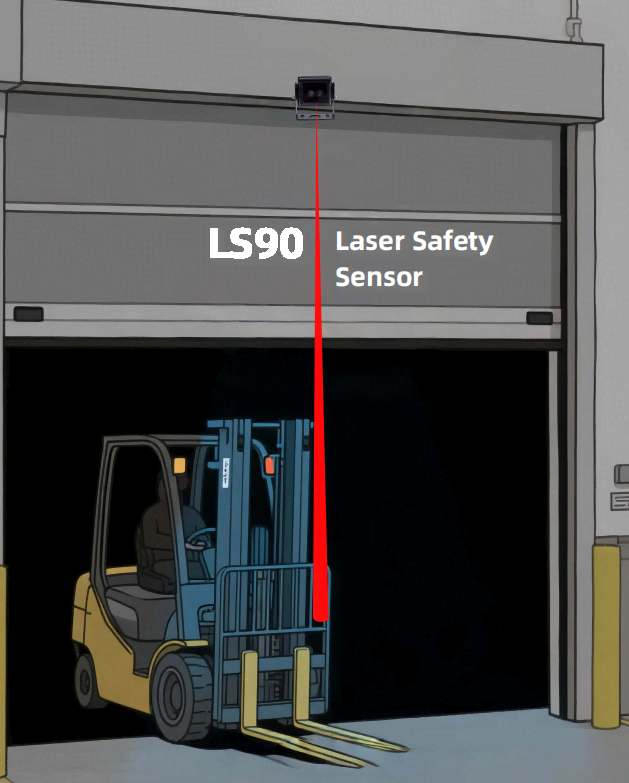
III. Micro Component Precision: Hardware Root Causes for Long-Term Performance Gaps
The performance gap between two radar types originates from different industrial adaptation standards of internal core components. Although classified as simple induction sensors, component precision directly determines energy consumption, repair cost and safety risk across the 3–5 year service cycle.
Signal Emission Core Chip Standard Microwave Radar: Civilian general microwave chip with centimeter-level wavelength, wide signal scattering range, incapable of distinguishing near & distant targets, signal reflection interference from metal & water vapor; Laser Sensor Radar: Automotive self-driving identical vehicle-grade laser chip with micron directional laser beam, non-diffusive signal, free of scattering interference from surrounding metal & water vapor, clear target contour identification;
Ranging Calculation Module Standard Microwave Radar: Only judges movement presence without accurate distance calculation, cannot separate pedestrians from trucks, triggers full door opening uniformly; Laser Sensor Radar: Built-in TOF time-of-flight arithmetic unit, millimeter recording of distance between objects and doorways, accurately differentiates small pedestrians and large forklifts to execute differentiated opening heights;
Low-Temperature Protection Structure Standard Microwave Radar: No dedicated low-temperature insulated housing, circuit sensitivity attenuates below -5℃, failure rate surges within half a year of cold storage installation; Laser Sensor Radar: Fully sealed freeze-resistant housing with low-temperature weather-resistant coating on all components, stable circuit operation at -40℃, compatible with all deep-freeze cold storage scenarios;
Commissioning Interaction Assembly Standard Microwave Radar: Only mechanical rotary knob adjustment on housing without visual markers, ladder disassembly mandatory for tuning with rough parameter precision; Laser Sensor Radar: Built-in Bluetooth wireless module paired with mobile visualized tuning interface, real-time light spot marking of detection boundaries, square-meter precise zoning adjustment with zero operation barriers.
Many enterprises opt for standard radar to cut upfront cost, ignoring hardware adaptation defects. Within six months of installation, frequent false triggers, door collision damage and skyrocketing electricity bills force radar replacement, leading to higher total expenditure in the long run. For high-traffic cold chain and heavy industrial plants, laser radar delivers superior economic performance across full service lifespan.
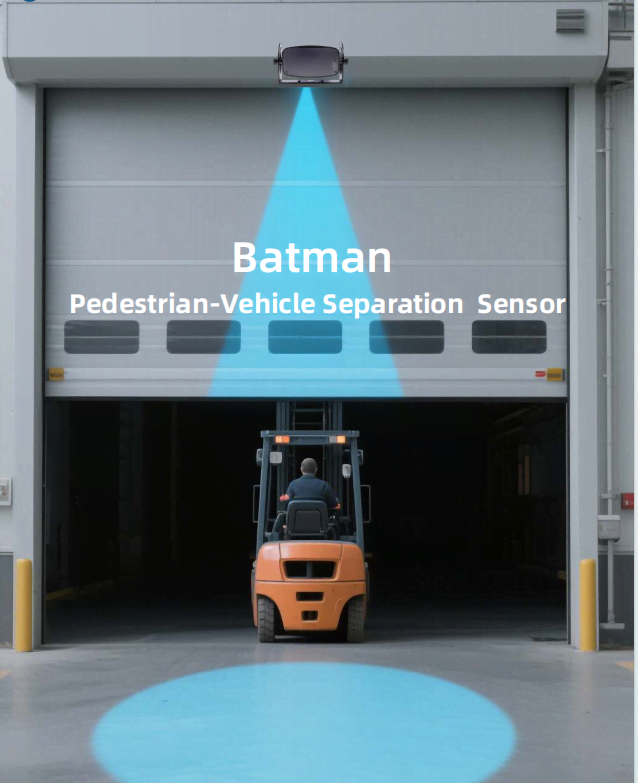
IV. Measurable Real-World Operational Benefit Comparison (Direct Reference for Cost Budgeting)
Instead of vague descriptions such as "good performance", we quantify measurable extra losses and gains based on real test data from industrial cold storage & logistics workshops:
Extra Cost Losses Caused by Standard Microwave Radar Deployment
Energy Waste Loss: No zoning function triggers full door opening for every passing pedestrian; monthly refrigeration electricity cost rises by $150 – $350 for a 5,000㎡ cold warehouse;
Equipment Repair Loss: Frequent stationary obstacle detection failure leads to annual door impact repair & bottom airbag replacement cost of $100 – $250;
Labor Maintenance Loss: Minimum two ladder sensitivity adjustments monthly, consuming 1–2 working hours per maintenance session;
Safety Liability Loss: Personnel pinching injuries under stationary doors & cargo collision damage create risk of workers’ compensation claims and total cargo write-offs.
Clear Measurable Gains from Laser Sensor Radar Installation
Energy Efficiency Gain: Pedestrian partial-opening zoning cuts hot-cold air exchange by over 15%, saving hundreds of dollars monthly on cooling power bills; the price difference of laser radar can be fully recovered within half a year;
Equipment Protection Gain: 10-meter long-distance anti-collision + full stationary detection eliminates almost all door, airbag and forklift impact damage, cutting annual repair cost by 90%;
Labor Maintenance Gain: Remote wireless parameter tuning via mobile APP removes the need for regular ladder disassembly adjustments, drastically cutting maintenance labor input;
Safety Control Gain: Full blind-spot-free continuous scanning completely eliminates pinching & cargo crushing hazards, avoiding workers’ compensation and cargo damage compensation costs.
V. Frequently Asked Industry Questions (Authentic User Spoken Queries Matched to Search Intent)
Q1: What issues will arise if standard microwave radar is installed in cold storage, and can it serve as a temporary workaround?
A: Standard microwave radar is not recommended for long-term cold storage deployment. Cold storage maintains permanent fog and extreme indoor-outdoor temperature difference, and fog scatters microwave signals triggering two critical failure modes: either radar fails to detect arriving forklifts and blocks passage, or floating frost & plastic packaging movement triggers random full door opening, creating continuous cold air leakage. Refrigeration compressors run at full load 24/7, lifting monthly power bills by over 20%. Low temperatures also degrade microwave chip sensitivity, creating severe pinching hazards for stationary unloading staff. It can only temporarily function in mild-temperature buffer zones; laser sensor radar is mandatory for freezing & deep-freeze warehouses.
Q2: Laser radar has higher upfront purchase cost – how quickly can I recoup the price difference?
A: Based on data from a standard 5,000㎡ cold storage facility, the price gap between laser radar and standard microwave radar ranges from $60 to $95. Energy savings from zoning control reduce monthly cooling bills by roughly $150, plus savings on door repair and maintenance labor hours. The full price difference can be recovered within 1–3 months at the fastest, and laser radar continuously generates energy-saving returns across its 3–5 year service cycle, delivering far lower total comprehensive cost than microwave radar long-term.
Q3: If a logistics aisle only accommodates forklifts with zero pedestrian traffic, is laser radar still necessary?
A: Laser radar remains strongly recommended. Standard microwave radar only detects moving forklifts; when forklifts stop stationary under doorways for unloading, the radar cannot identify parked vehicles, and delayed door descent will crash into forklift tines. Laser radar continuously detects all stationary objects within coverage while enabling 10-meter advance door opening to eliminate forklift deceleration waiting, lifting passage efficiency and preventing permanent door impact damage.
Q4: For heavy-dust food processing plants, will dust accumulation on laser radar lenses cause sensor failure?
A: Dust buildup will not disable laser radar operation. Laser radar transmits narrow directional beams; minor dust coverage cannot fully block signal transmission, offering far superior dust resistance compared to widely scattered microwave signals. The lens adopts smooth fully sealed housing, requiring only 10 seconds of dry cloth wiping for daily dust cleaning. Built-in light spot visualization instantly alerts operators to reduced detection range from dust buildup, eliminating unforeseen complete sensor shutdowns.
Q5: If my high-speed door already has standard microwave radar fitted, can I directly replace it with laser radar later?
A: Direct replacement is fully supported. Both radar types adopt unified DC24V power supply and fully compatible signal output interfaces, requiring zero modification to existing door controllers or motor wiring. Simply remove the original microwave radar, mount the laser radar unit and connect power cables; full replacement installation finishes within 30 minutes with extremely low retrofit barriers.
Recommended Products


latestAutomatic Door Accessories
- Safety Edge Sensor for Rapid Roll Door Anti-Crushing Protection
- High-Speed Door 0.75KW Servo Motor Control Box Set – Reliable & Efficient Drive Solution
- 1.5KW Servo Motor & Control Box Combination - High-Efficiency Drive System for Industrial Doors
- Industrial Door Zippers & High Speed Door Zippers - Durable Industrial Door Accessories
- 0.75KW High-Speed Door Servo Drive System - Reliable & Energy-Saving Industrial Solution
- Manufacturers Foot Pedal Activator & Safety Beam Photocell Barrier Sensor for Medical Sliding Doors
- Industrial Door Zippers & High Speed Door Zippers - Durable Industrial Door Accessories
- AOK-AC123 Electric Curtain Remote Control - Wireless Design with Wear-Resistant Acrylic Crystal Pane
- Permanent Magnet AC Synchronous Servo Motor with Worm Reduction Mechanism for High Speed Door
- Precision Synchronous Servo Motor for High-Speed Door – Worm Gear Reduction
- New Surface-Mounted Waterproof Infrared Sensor Switch
- Durable PVC Fast Rolling Door Fittings for Enhanced Security
- Automatic Repair of Zipper Door Plastic/Polymer Rails
- Smart Automatic Door Sensor for Fast Rolling Access Control
- Soft Fast Gate Control System 1.5kw Servo Motor and Control Box
- Automatic Access Control Square Surface Mount Infrared Non-Contact Switch
- Explosion-Proof Reinforced Self-Limiting Electric Heating Belt
- Explosion-Proof Shielded Self-Controlling Temperature Electric Heating Belt
- Heating Belt for Anti-Freezing, Heating and Heat Preservation of Cold Storage Doors
- 40W flame retardant explosion-proof self-limiting electric heating belt
