

Why Cold Chains Must Use Special Low-Temperature Cold Storage Doors
I. Cold storage insulated high-speed doors form the largest cold energy loss gap in the cold chain industry. Traditional manual sliding cold storage doors operate at an opening and closing speed of only 0.2-0.5m/s. Each time a forklift passes through, the doorway remains exposed for more than 10 seconds, allowing massive amounts of high-temperature and high-humidity outdoor air to rush into the warehouse. On one hand, this forces cold storage compressors to run under continuous overload, resulting in skyrocketing electricity costs. On the other hand, hot and humid air rapidly forms frost and ice when encountering low temperatures, accumulating on door frames and evaporators, which further reduces cooling efficiency and shortens equipment service life.
Low-temperature cold storage high-speed doors are special equipment developed to address this industry pain point. Their overall working logic can be briefly summarized as: Fast opening and closing to reduce hot-cold air exchange, thick layered barriers to block heat transfer, constant temperature heating to prevent icing failures, all-round sealing to lock low-temperature air, and intelligent sensors to avoid safety accidents.
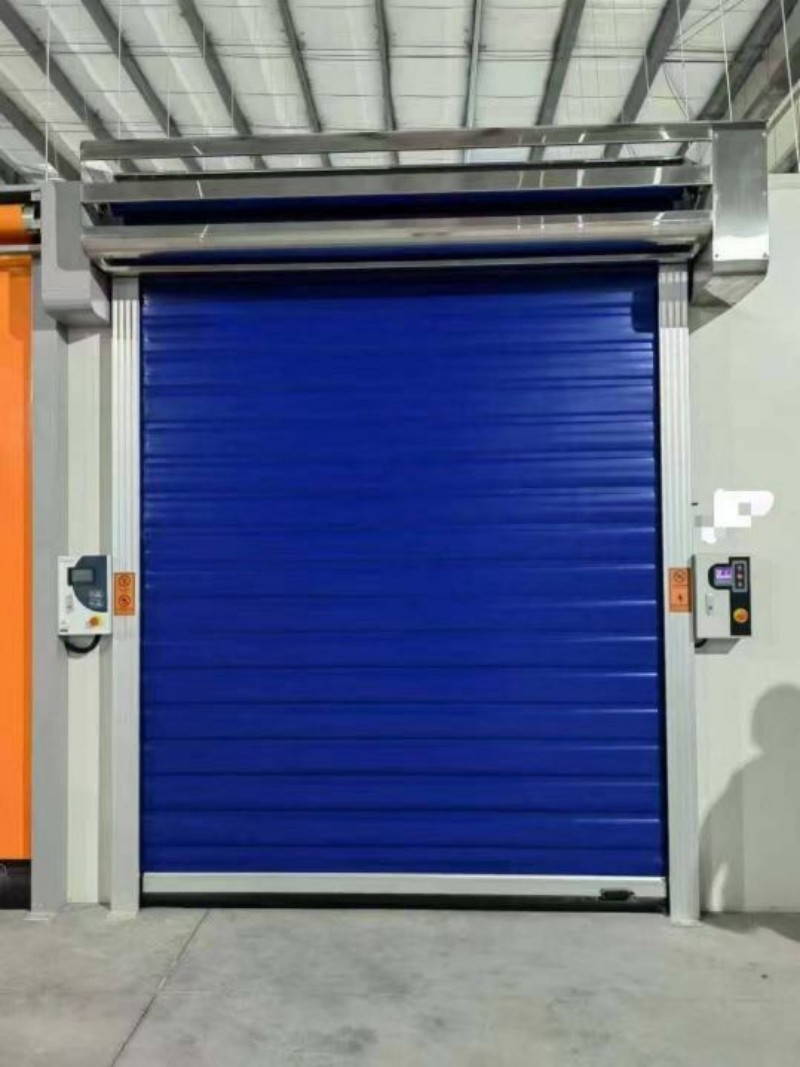
Detailed Applicable Scenarios
Freezer Warehouses (-18℃~-30℃): Long-term storage warehouses for meat, seafood and frozen food;
Chiller Warehouses (0℃~5℃): Transit warehouses for fruits, vegetables, fresh milk and prepared dishes;
Cold Chain Loading & Unloading Aisles: Buffer transition areas between normal outdoor temperature and low-temperature warehouses, with an internal-external temperature difference of over 40℃;
Pharmaceutical Low-Temperature Warehouses: Storage workshops for reagents and vaccines at 2-8℃ with extremely high requirements for temperature stability.
| Comparison Item | Traditional Sliding Cold Storage Doors | Low-Temperature Cold Storage High-Speed Doors |
|---|---|---|
| Opening & Closing Speed | Opening speed: 0.2~0.5m/s, doorway exposed for over 10 seconds per pass | Opening speed: 0.8~1.5m/s, closing speed ≥0.6m/s, doorway exposed for ≤3 seconds per pass |
| Thermal Insulation Structure | Single-layer thin insulation board with severe air leakage through gaps | 5-6 layered composite PVC insulation curtain, total thickness 14~20mm with airtight heat insulation interlayers |
| Anti-Icing Capacity | No heating device; easily jammed by ice below -10℃, requiring manual ice chiseling | Built-in heating anti-freeze mechanism in guide rails; no icing jamming down to -30℃ with automatic defrosting |
| Energy Consumption Performance | Massive cold air loss, increasing daily power consumption of cold storage by 20%~35% | Greatly reduced hot-cold air exchange, cutting daily power consumption by 15%~28% |
| Passage Efficiency | Manual push-pull operation, long waiting time for forklifts, limited daily cargo throughput | Radar / ground magnetic automatic induction, no manual operation required, passage efficiency tripled |
| Safety Configuration | Only basic anti-collision function without anti-pinch sensors, high risk of personnel injury and cargo damage | Dual protection of infrared light curtain + bottom safety airbag; door rebounds immediately when obstacles are detected |
| Long-Term Maintenance Cost | Frequent de-icing work, sealing strips replaced every six months, frequent downtime due to failures | Constant-temperature rails reduce frost accumulation, durable sealing parts, annual maintenance cost reduced by 60% |
II. Five Core Systems: Medium Working Principles of Low-Temperature Cold Storage Doors
A complete cold storage high-speed door does not operate via separate components alone. Instead, five modules work collaboratively: Insulation Curtain Thermal Barrier System, Heating Anti-Freezing System, Servo Drive Lifting System, All-Round Airtight Sealing System and Intelligent Safety Control System. Each system performs its own functions to jointly stabilize the low-temperature environment.
2.1 Multi-Layer Insulation Curtain Thermal Barrier System (Core Barrier Blocking Heat Exchange)
The PVC insulation curtain (Definition: Flexible rolling curtain fabric based on polyvinyl chloride and filled with special thermal insulation materials) is the most critical structure for isolating hot and cold air. It adopts a 5-6 layer "sandwich" composite structure: two thickened wear-resistant PVC layers on the inside and outside for protection, and high-density thermal insulation materials filled in the middle interlayer, with a stable overall thickness of 14mm-20mm.
In terms of physical principles, heat transfer includes three forms: conduction, convection and radiation. A large amount of stationary air is enclosed inside the multi-layer interlayers. Air has a much lower thermal conductivity than solid materials, which directly cuts off heat conduction channels. The multi-layer stacked structure also eliminates direct convective exchange of air inside and outside the warehouse. After the door is closed, the air leakage rate can be controlled at an extremely low level to avoid continuous loss of cold energy.
Special PVC sealing edges are equipped on both sides of the curtain, which tightly lock into aluminum alloy guide rails when the door closes to prevent cold air leakage through gaps. Meanwhile, the fabric resists cracking under low temperatures and will not harden, embrittle or break even after long-term operation at -30℃.
2.2 Heating Anti-Freezing System (Exclusive Design to Solve Low-Temperature Ice Jamming)
The fatal defect of ordinary high-speed doors that prevents their use in freezers is the lack of anti-freezing structure. Hot and humid outdoor air enters the rail gaps and instantly freezes when exposed to low temperatures, jamming the curtain and stopping door lifting. Low-temperature cold storage high-speed doors are equipped with a heating anti-freezing device (Definition: Constant-temperature heating components pre-embedded inside guide rails and motor cabinets), which is the core technology enabling them to adapt to subzero extreme cold.
Heating components are installed inside bilateral aluminum alloy guide rails, stainless steel control cabinets and motor housings, continuously maintaining the temperature of rail contact surfaces above the dew point to prevent water vapor from forming frost and ice. The equipment can operate stably in the temperature range of -30℃ to +60℃, fully covering all temperature zones of chillers and deep freezers. It completely eliminates the cumbersome work of manual ice chiseling and shutdown defrosting, supporting 24-hour uninterrupted cargo handling.
2.3 Servo Drive Lifting System (Power Source for High-Speed Opening & Closing)
The lifting mode adopts a dual-drum lifting structure, matched with a 1.5kW special low-temperature resistant stainless steel servo motor (Definition: Special drive motor adapted to low-temperature environments with precisely controllable start-stop speeds) and multi-turn absolute value encoders for electronic limit positioning.
The opening speed is adjustable from 0.8-1.5m/s, and the closing speed is no less than 0.6m/s. The door fully rises instantly when a forklift approaches and drops to close immediately after the vehicle passes, minimizing the time the doorway is open and reducing hot-cold air exchange at the source. Electronic limits eliminate manual mechanical adjustment; the lifting height can be set with one click inside the stainless steel control cabinet, with ultra-small positioning error and stable jitter-free operation.
2.4 All-Round Airtight Sealing System (Comprehensively Lock Cold Air Inside the Warehouse)
The sealing is divided into three parts: top sealing, bottom airbag sealing and bilateral rail sealing, forming a 360° dead-angle-free airtight barrier:
Two sides: Special PVC sealing edges fit tightly against 3.0mm thick aluminum alloy guide rails, almost fully closing all gaps;
Bottom: Elastic safety airbag sealing adapts to slight ground unevenness, fully fitting the ground after door closure to block ground air leakage channels;
Top: The housing frame is made of 304 stainless steel, fitted with sealing rubber strips to block top gaps.
The complete sealing structure effectively isolates air pressure convection on both sides of the door and prevents continuous cold air leakage through gaps. Under the same working conditions, the airtight performance is over 80% higher than traditional cold storage doors. In addition, wear-resistant and tightly fitted door guiding components deliver Class 6 wind resistance per national standards, avoiding door curtain shaking and sealing separation even in strong outdoor winds.
2.5 Intelligent Safety Control & Sensor System (Balance Automation and Operation Safety)
The overall protection rating of the control system reaches IP54 (Definition: Waterproof and dustproof protection standard that can resist splashing water and dust intrusion into equipment), complying with national electrical safety standards, and is not prone to short-circuit damage in harsh cold storage environments with high humidity and drastic temperature differences.
1) Safety Protection Principle (Dual Safety Design)
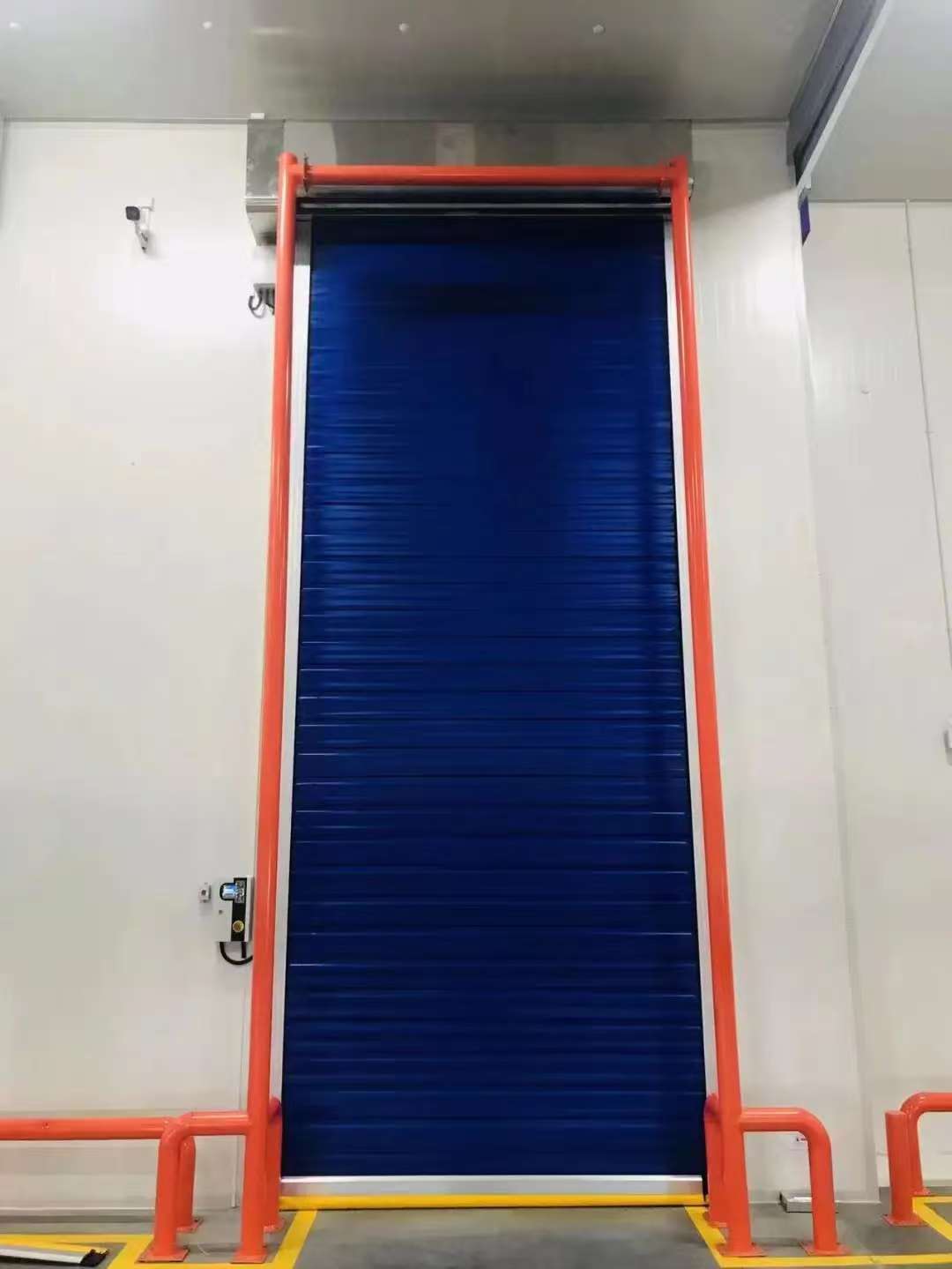
Infrared light curtain: Induction beams are arranged on the left and right of the door frame. If personnel or goods block the beams while the door descends, the door immediately stops lowering and fully opens, closing with a delay after obstacles are cleared;
Bottom safety airbag: Infrared sensors have blind zones. If the curtain presses against obstacles, the airbag is compressed to trigger rebound, rapidly lifting the door to the fully open position to prevent personnel crushing and cargo damage. Both functions come as standard factory configurations.
2) Multiple Intelligent Opening Control Logic
The basic configuration includes manual button operation via the control cabinet. Optional upgrades include radar sensors (auto-open when forklifts approach), ground loop sensors (door triggered when vehicles roll over the sensing area), Bluetooth RF modules, remote controls and pull-cord switches, adapting to different warehouse operation processes. Operators do not need to get off vehicles to manually open doors throughout the process, greatly improving loading and unloading efficiency.
III. Micro Component Principles: How Each Accessory Ensures Stable Low-Temperature Operation
The long-term stable operation of the complete cold storage door under subzero temperatures relies on low-temperature adaptive design of every component. Tiny structures directly determine equipment service life and thermal insulation performance:
Guide Rails & Frames: Bilateral rails are made of 3.0mm thickened aluminum alloy with uniform thermal conductivity for efficient heat transfer from heating devices and strong deformation resistance. The top housing frame uses 304 stainless steel to resist water vapor corrosion without rusting in high-humidity cold storage environments;
Control Cabinets & Motors: Special low-temperature resistant stainless steel cabinets with internal circuit insulation protection to prevent wire hardening and cracking under low temperatures. Servo motors adopt anti-freeze lubricating grease with unattenuated power output at -30℃. Multi-turn absolute encoders accurately record door position without positioning deviation after frequent lifting cycles;
Curtain Sealing Accessories: PVC sealing strips are blended with cold-resistant additives to maintain elasticity at low temperatures without hardening and losing sealing performance. The bottom airbag is made of low-temperature flexible rubber, resisting breakage from repeated compression;
Heating Circuit Accessories: Heating cables are treated for low-temperature weather resistance to avoid cracking and electric leakage under alternating hot and cold conditions, matched with leakage protection devices to guarantee electricity safety.
These tiny accessories seem insignificant, yet they solve a series of failures of ordinary industrial doors in cold storage environments such as rusting, frost cracking, positioning failure and electric leakage. They support millions of stable opening and closing cycles for the complete equipment and reduce long-term operation and maintenance costs.
IV. Summary of Practical Benefits of Low-Temperature Cold Storage Doors
Combined with the foregoing working principles, we can clearly calculate tangible benefits brought by the equipment, rather than vague descriptions of "good performance and energy saving":
Energy-Saving Benefits: The dual effect of high-speed opening/closing and multi-layer airtight insulation reduces the load on cold storage refrigeration compressors by 15%-28%. A medium-sized 5,000㎡ freezer can save thousands of dollars in electricity bills every month;
Efficiency Benefits: Automatic sensor opening triples opening and closing speed, cutting single forklift passage time by 70%. Cargo throughput rises within the same working hours without additional forklifts and labor;
Operation & Maintenance Benefits: Built-in rail heating eliminates daily manual ice chiseling and defrosting. Stainless steel and cold-resistant components have low failure rates, cutting annual repair and replacement part costs by 60%;
Cargo Benefits: The temperature fluctuation range inside the warehouse is greatly narrowed, preventing repeated thawing and spoilage of frozen goods, lowering cargo loss rates and stabilizing storage quality of fresh and frozen food;
Safety Benefits: Dual sensor protection eliminates pinching and cargo crushing accidents, reducing compensation costs for work injuries and damaged goods.
V. Frequently Asked Industry Questions (Common Real-World Customer Queries)
Q1: Can standard high-speed doors be directly installed in -20℃ freezers?
No. Standard high-speed doors lack rail heating anti-freeze mechanisms and feature thin single-layer curtains without thermal insulation interlayers. Rails rapidly ice up under low temperatures and jam door movement. In addition, standard motors and sealing components cannot withstand cold conditions and crack quickly, causing severe cold leakage and sharp electricity bill hikes. They are only suitable for normal-temperature workshops and chiller buffer rooms above 0℃.
Q2: Will running the heating device of low-temperature cold storage doors 24 hours a day consume excessive electricity?
It will not consume excessive power. The heating device adopts automatic constant temperature control, only activating when the rail temperature drops below the frost threshold and powering off once the target temperature is reached. The heating power is low, with each door consuming only a few kilowatt-hours of heating electricity per day. Compared with the electricity consumed by cold storage compressors running under overload due to cold leakage, energy savings far exceed heating power consumption.
Q3: What does Class 6 wind resistance mean for low-temperature cold storage doors, and are they suitable for outdoor aisles?
National Standard Class 6 wind resistance corresponds to outdoor wind speeds of 10.8~13.8m/s, classified as strong wind level. As long as the bilateral door sealing is intact and rails are firmly fixed, the doors are fully applicable to outdoor cold storage loading and unloading aisles. No curtain bulging or gap air leakage occurs in strong winds, enabling stable use even in windy coastal areas.
Q4: What automatic opening modes can be equipped on low-temperature cold storage doors, and which is the most suitable for cold chain warehouses?
Optional configurations include radar sensors, ground loop detectors, remote controls, Bluetooth RF modules and pull-cord switches. For cold chain facilities with frequent forklift access, ground loop sensors are preferred. They only trigger door opening when vehicles roll over the sensing area and avoid false activation caused by pedestrian movement. Radar sensors can be installed for pedestrian walkways to separate vehicle and foot traffic and optimize warehouse operation workflows.
Q5: What is the minimum operating temperature of low-temperature cold storage doors, and are they compatible with pharmaceutical vaccine warehouses?
The equipment operates stably from -30℃ to +60℃ and is fully suitable for 2~8℃ pharmaceutical vaccine warehouses. The multi-layer insulation structure limits indoor temperature fluctuation within ±0.5℃, while the airtight structure blocks hot and humid outdoor air to prevent reagent and vaccine deterioration caused by temperature differences, meeting strict pharmaceutical cold chain temperature and humidity control standards.
Recommended Products


latestAutomatic Door Accessories
- Safety Edge Sensor for Rapid Roll Door Anti-Crushing Protection
- High-Speed Door 0.75KW Servo Motor Control Box Set – Reliable & Efficient Drive Solution
- 1.5KW Servo Motor & Control Box Combination - High-Efficiency Drive System for Industrial Doors
- Industrial Door Zippers & High Speed Door Zippers - Durable Industrial Door Accessories
- 0.75KW High-Speed Door Servo Drive System - Reliable & Energy-Saving Industrial Solution
- Manufacturers Foot Pedal Activator & Safety Beam Photocell Barrier Sensor for Medical Sliding Doors
- Industrial Door Zippers & High Speed Door Zippers - Durable Industrial Door Accessories
- AOK-AC123 Electric Curtain Remote Control - Wireless Design with Wear-Resistant Acrylic Crystal Pane
- Permanent Magnet AC Synchronous Servo Motor with Worm Reduction Mechanism for High Speed Door
- Precision Synchronous Servo Motor for High-Speed Door – Worm Gear Reduction
- Durable PVC Fast Rolling Door Fittings for Enhanced Security
- Automatic Repair of Zipper Door Plastic/Polymer Rails
- Smart Automatic Door Sensor for Fast Rolling Access Control
- Soft Fast Gate Control System 1.5kw Servo Motor and Control Box
- Automatic Access Control Square Surface Mount Infrared Non-Contact Switch
- Explosion-Proof Reinforced Self-Limiting Electric Heating Belt
- Explosion-Proof Shielded Self-Controlling Temperature Electric Heating Belt
- Heating Belt for Anti-Freezing, Heating and Heat Preservation of Cold Storage Doors
- 40W flame retardant explosion-proof self-limiting electric heating belt
- Safety Beam Sensor Use for Automatic Door
