

How to Choose the Right High-Speed Door? A Comprehensive Guide
1. Core Types of High-Speed Doors and Their Applications
High-speed doors can be categorized into the following types based on material, drive mechanism, and functionality, each with unique advantages and suitable environments:
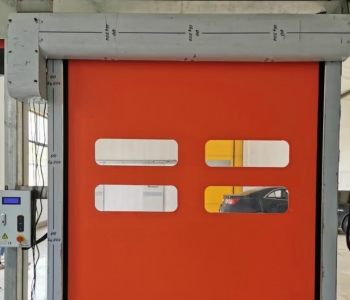
1. PVC High-Speed Roll-Up Door
Material: High-density polyester fabric with PVC coating, offering strong tear resistance.
Speed: Opening speed 0.6–1.5 m/s, closing speed 0.5–1.2 m/s.
Applications: Warehouses, food processing plants, pharmaceutical cleanrooms.
Key Advantages:
Excellent sealing to prevent dust and insects, ideal for high-cleanliness environments.
High durability for frequent use (1,000+ cycles per day).
2. Metal High-Speed Door (Aluminum/Stainless Steel)
Material: Aluminum alloy or stainless steel slats, offering high impact resistance.
Speed: Opening speed 1.0–2.0 m/s, suitable for high-frequency use.
Applications: Large factories, garages, heavy-duty logistics centers.
Key Advantages:
Extreme durability, resistant to strong winds (wind pressure resistance ≥ Grade 8) and mechanical impacts.
Thermal insulation, ideal for regions with large temperature variations.
3. High-Speed Stacking Door
Material: Double-layer PVC fabric or soft fiber.
Speed: Opening speed 0.8–1.2 m/s, vertically stacked when retracted.
Applications: Large warehouse entrances, cold chain logistics.
Key Advantages:
Space-saving design, as the door stacks vertically without requiring side clearance.
High wind resistance, suitable for large openings (width up to 10+ meters).
4. Ultra-High-Speed Door
Speed: Opening speed ≥ 2.0 m/s, designed for industrial high-frequency use.
Applications: Automated production lines, robotic workstations.
Key Advantages:
Seamless integration with automation systems, supporting PLC or photoelectric sensors.
Exceptional longevity, with motors tested for over 1 million cycles.

2. Key Parameters for Choosing a High-Speed Door
1. Door Material
PVC: Lightweight and cost-effective but may degrade under prolonged sun exposure (lifespan ~5–8 years).
Metal: Longer lifespan (10–15 years) but higher cost.
Tear resistance: High-quality PVC doors should have a tear strength ≥ 600 N/cm².
2. Drive System
Motor Type:
AC motor: Lower cost, suitable for low-frequency use (≤500 cycles/day).
Servo motor: Precise control, ideal for high-frequency applications (≥1,000 cycles/day).
Opening/Closing Speed: For logistics, choose doors with speeds ≥ 1.2 m/s.
3. Safety Features
Infrared sensors: Prevent accidents, with a detection range ≥ 30 cm.
Bottom safety edge: Auto-reverse function triggered by ≤ 5 kg of pressure.
4. Sealing and Insulation
Sealing Grade:
Standard doors: Gaps ≤ 5 mm.
High-seal doors: Gaps ≤ 1 mm (ideal for cold storage and cleanrooms).
Insulation Coefficient: A U-value ≤ 1.5 W/(m²·K) can reduce energy loss by 30%+.

3. Application Scenarios and Selection Guide
| Scenario | Recommended Door | Key Requirements |
|---|---|---|
| Food processing | PVC high-speed door | Dustproof, insect-proof, easy to clean |
| Automotive plants | Metal high-speed door | Impact-resistant, heat-resistant |
| Cold storage | Stacking door | Insulated, windproof |
| Automated sorting | Ultra-high-speed door | High frequency, system integration |

4. Frequently Asked Questions (FAQ)
1. What is the typical lifespan of a high-speed door?
A high-quality high-speed door lasts 8–15 years under normal use: PVC doors last ~5–8 years, while metal doors can exceed 10 years. Daily cycles and maintenance are key factors.
2. How to check if a high-speed door is properly sealed?
Two tests:
Light test: No visible light leakage when closed.
Wind test: No door movement under ≤ Grade 6 winds.
3. Can high-speed doors integrate with automation systems?
Yes. Most industrial doors support RS485, dry contacts, or Profinet for PLC/MES integration.
4. What safety features do high-speed doors have?
Standard: Infrared sensors, safety edges, emergency stop. Optional: Radar detection, breakaway cable systems.
5. Is after-sales service important when buying a high-speed door?
Critical. Core components (motors, controls) should have at least a 2-year warranty, and suppliers should offer local support to minimize downtime.
By following this guide, you can select the best high-speed door for your needs. Define your scenario, focus on key specs, and verify service support for optimal results. For further advice, provide door dimensions and usage frequency for a tailored solution.
Recommended Products


up to dateArgentina Automatic Door Accessories
- Manufacturers Foot Pedal Activator Safety Beam Photocell Barrier Sensor For Medical Sliding Doors
- Safety photoelectric switch for high-speed door sensors
- Durable PVC Fast Rolling Door Fittings for Enhanced Security
- Automatic Repair of Zipper Door Plastic/Polymer Rails
- Smart Automatic Door Sensor for Fast Rolling Access Control
- Soft Fast Gate Control System 1.5kw Servo Motor and Control Box
- Automatic Access Control Square Surface Mount Infrared Non-Contact Switch
- Explosion-Proof Reinforced Self-Limiting Electric Heating Belt
- Explosion-Proof Shielded Self-Controlling Temperature Electric Heating Belt
- Heating Belt for Anti-Freezing, Heating and Heat Preservation of Cold Storage Doors
- 40W flame retardant explosion-proof self-limiting electric heating belt
- High Speed Door Zippers Industrial Door Zippers
- Safety Beam Sensor Use for Automatic Door
- Wireless Hand Sensor Switch For Automatic Door
- Hospital Door Foot Sensor
- Automatic Sliding Door System Wireless Touch Press Switch
- Automatic Sliding Door IP65 Waterprooft Wireless Hand Press Switch
- Automatic Door Microwave Sensor
- Reflective Type Infrared Detector
- Automatic High Speed Door Infrared Radar Sensor CNB-204G
